English
 عربى
عربى русский
The Industrial Efficiency and Structural Integrity of Modern Three-Piece Packaging
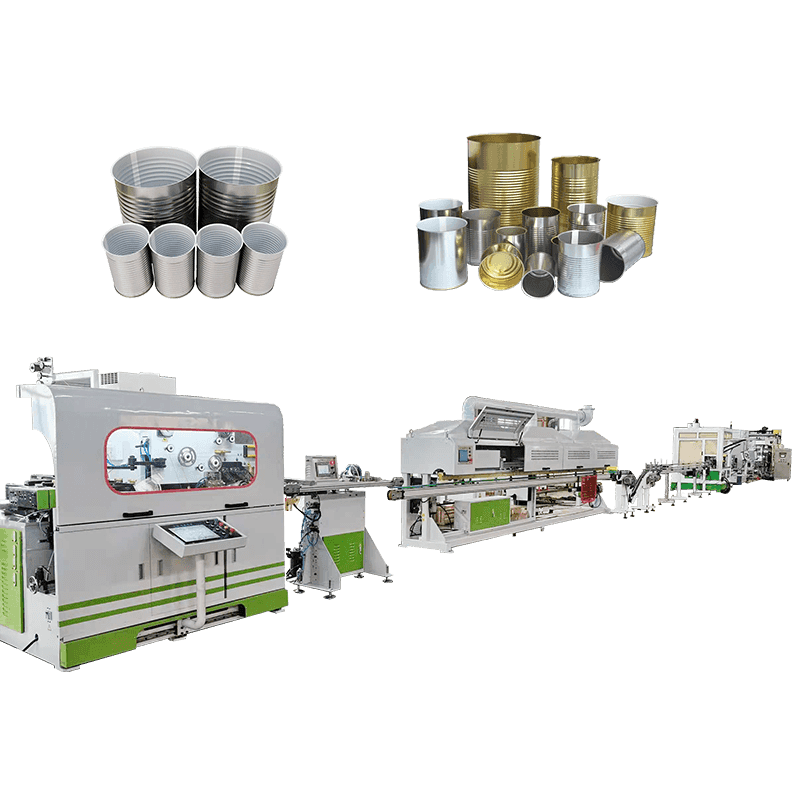
Implementing an automated, high-speed 3 piece food tin can production line provides large-scale food processors, tinplate packaging factories, and canning facilities with a highly adaptable, metallurgically secure solution for manufacturing hermetically sealed storage containers. By integrating automated sheet slitting, high-frequency resistance seam welding, thermal induction lacquering, and mechanical multi-die combination processes, these systems transform flat tinplate coils into structurally sound cylindrical packages. This manufacturing architecture delivers a production output rate exceeding 500 cans per minute under continuous operational cycles, ensuring absolute barrier protection against atmospheric oxygen and bacterial infiltration. This setup achieves a near-zero leakage defect rate of less than 1 in 100,000 units, completely outperforming alternative composite or legacy soldering methods.
Within heavy-duty food preservation industries, managing high-temperature retort cooking forces manufacturers to deploy rigid containers that resist severe pressure changes without buckling. Three-piece cans—consisting of a rolled body cylinder, a bottom end component, and a top closure lid—offer exceptional vertical stacking strength and dimensional versatility. Unlike two-piece drawn-and-ironed configurations that require millions of units in a single size to justify expensive deep-drawing tooling costs, a three-piece manufacturing sequence can be re-calibrated quickly. This allow operators to adjust can height profiles inside a single working shift, helping factories maintain high Overall Equipment Effectiveness (OEE) while running a diverse product catalog.
Metallurgical Sequence and High-Frequency Resistance Welding Dynamics
The long-term sealing safety and mechanical strength of a three-piece container depend on precision material handling and the execution of the longitudinal weld seam.
Sheet Slitting and Precision Body Blank Flexing
The process begins as large sheets of electrolytically coated tinplate feed through circular slitter knives that cut the raw material into exact rectangular body blanks. These blanks pass immediately through a dynamic flexing machine equipped with an array of staggered steel rollers. This rolling action eliminates the steel's natural yield point elongation, relieving internal material stresses and ensuring that when the sheet is later rolled into a cylinder, it forms a perfectly round shape free of flattened faces or egg-shaped distortions.
High-Frequency Continuous Wire Seam Welding
The curved blank slips into a specialized welding station where the longitudinal edges are overlapped by just 0.3 to 0.5 millimeters. A high-purity copper wire runs continuously between upper and lower welding wheels to act as an intermediate electrode material. As the can body passes through the machine, high-frequency current pulses (ranging from 150 to 500 Hz) apply intense heat and forge pressure, welding the steel edges together without requiring flux or solder. This step creates a thin, clean weld seam that preserves the base metal's original mechanical strength.
Comparative Technical Evaluation: Automated 3 Piece Production Lines vs. Integrated 2 Piece D&I Line Configurations
Selecting the ideal rigid packaging infrastructure requires weighing production output speeds against initial tooling costs, format changeover times, and target material thickness profiles. The comparison table below highlights the operational limits of the two dominant metal packaging strategies.
| Operational Parameter Profile | Automated 3 Piece Food Tin Can Production Line | Integrated 2 Piece Drawn & Ironed (D&I) Line |
|---|---|---|
| Initial Capital Tooling Expenditure | Moderate (Accessible entry threshold for regional plants) | Extreme (Requires massive high-tonnage multi-die cup presses) |
| Dimensional Profile Flexibility Duration | High (Height modifications completed within 2 - 4 hours) | Low (Requires days of retooling ironer rings and punches) |
| Vertical Stacking Axial Crush Strength | Superior (Thicker body wall supports high stack loads) | Moderate (Ultra-thin ironed walls rely on internal pressure) |
| Minimum Economic Run Threshold | Low (Profitable batch cycles starting at 50,000 units) | Extreme (Requires millions of units per run to offset costs) |
| Material Utilization Factor | Standard (Rectangular slitting leaves minimal web scrap) | Optimized (Continuous deep drawing reduces final unit weight) |
The data comparison highlights a clear engineering split between high-volume packaging strategies. Two-piece D&I lines deliver extreme speeds for high-volume beverage runs where billions of identical aluminum or steel cans pass through without changes. However, for the agricultural food canning sector—which deals with seasonal crops, varying filling weights, and thick contents like corn or meat—the three-piece line remains the industry standard. Its ability to run thicker tinplate bodies ensures the cans survive the internal vacuum stresses of high-temperature retort processing ovens without collapsing inward.
Advanced Inline Thermal Lacquering and Mechanical Combination Systems
Modern three-piece tinplate manufacturing setups include specialized post-welding coating equipment and multi-die finishing machines to guarantee complete corrosion defense and precise dimensions.
- Electrostatic Seam Liquid/Powder Coating: Because the high welding heat burns away the initial tin layer along the seam, specialized spray arms apply an organic liquid or epoxy-phenolic powder coat over the raw steel bead. This protective patch cures instantly under induction heat to shield the metal from acidic foods.
- Mechanical Body Bead Rollers: The welded cylinder passes through expanding mandrels equipped with hardened profiling rings. These tools press concentric horizontal ribs, or beads, into the thin metal walls, increasing the can't resistance to external crush forces by up to 60%.
- Multi-Stage Die Flanging and Seaming Stations: The ends of the can body are flared outward at a 90-degree angle to create consistent flanges. An automated seaming mechanism interlocks this body flange with a pre-stamped bottom end disc, rolling the metals together under high pressure to create a tight, double-seam seal.
Step-by-Step Equipment Synchronization and Quality Control Protocol
Because single-machine glitches can stall an entire production facility, manufacturing lines rely on a highly synchronized, automated control sequence.
- Tinplate Surface Inspection: Pass raw steel sheets through a multi-channel optical sorter to scan for scratches, tin layer thin spots, or surface defects, automatically rejecting substandard sheets before they enter the slitter.
- High-Speed blank Transfer Monitoring: Transport slit blanks into the welder magazine via magnetic overhead conveyors. Use proximity sensors to track blank spacing and prevent double-sheet entries that could jam the welding rollers.
- Welding Heat Micro-Regulation: Link the welder's power system to an optical sensor that tracks line speed. If the production line slows down slightly, the system automatically dials down the current to prevent burning through the thin steel edge.
- Visual Seam Integrity Audit: Direct the welded cylinders past a high-resolution, multi-camera system. The system inspects the interior lacquer patch for micro-voids or bubbles, tracking defects in real time at full production speed.
- High-Pressure Air Leakage Rejection: Feed finished cans into a multi-station rotary air tester. Pressurize each can to 1.5 bar for a calibrated period; if a sensor detects a pressure drop, the pneumatic ejector arm shifts that unit into the scrap bin.
Mitigating Micro-Pinhole Delamination and Managing Flange Splitting
While professional three-piece tinplate lines use advanced automated controls, improper thermal profiles or variations in metal temper can cause structural failures during high-speed production.
Preventing Micro-Pinhole Lacquer Delamination
Pinhole delamination occurs if the induction curing oven temperature rises too quickly after the seam coating station. Fast heating forces moisture out of the wet resin prematurely, leaving behind tiny pinholes that expose raw steel to acidic food contents, which can trigger localized corrosion and spoilage. Operators can control these coating defects by using multi-zone convection pre-heating tubes to ramp up temperatures gradually, allowing solvents to evaporate cleanly before final curing.
Controlling High-Velocity Mechanical Flange Splitting
Flange splitting happens when a flanging machine flares out the edges of a can body made from over-hardened or brittle steel blanks. The intense stress can rip the metal along the weld seam, ruining the container. Production engineers can prevent this splitting by adjusting the welder's cooling parameters to soften the seam bead and matching the die profiles to the steel's specific hardness rating, ensuring smooth, split-free flanging operations at full line speeds.