English
 عربى
عربى русский
Automation Compatibility of the 3 piece food tin can production line
The discussion around the level of automation within a 3 piece food tin can production line often centers on whether such a system can be configured as fully automatic or semi-automatic. The flexibility of a tin can production line is influenced by its mechanical structure, control logic, and the intended productivity requirements of the facility. A modern 3 piece food tin can production line is designed to support multiple production modes so it can meet different manufacturing scales. The ability to choose between full automation and semi-automation allows factories to adjust investment budgets while maintaining consistent output needs. The system design in a can production line usually integrates welding, coating, curing, flanging, seaming, and inspection modules, and each of these stages may be automated to different extents depending on operational goals. When companies evaluate the configuration options, they often consider labor availability, cost control, technical familiarity, and whether the desired efficiency matches the automation level being implemented.
Structural Considerations for Automation in a tin can production line
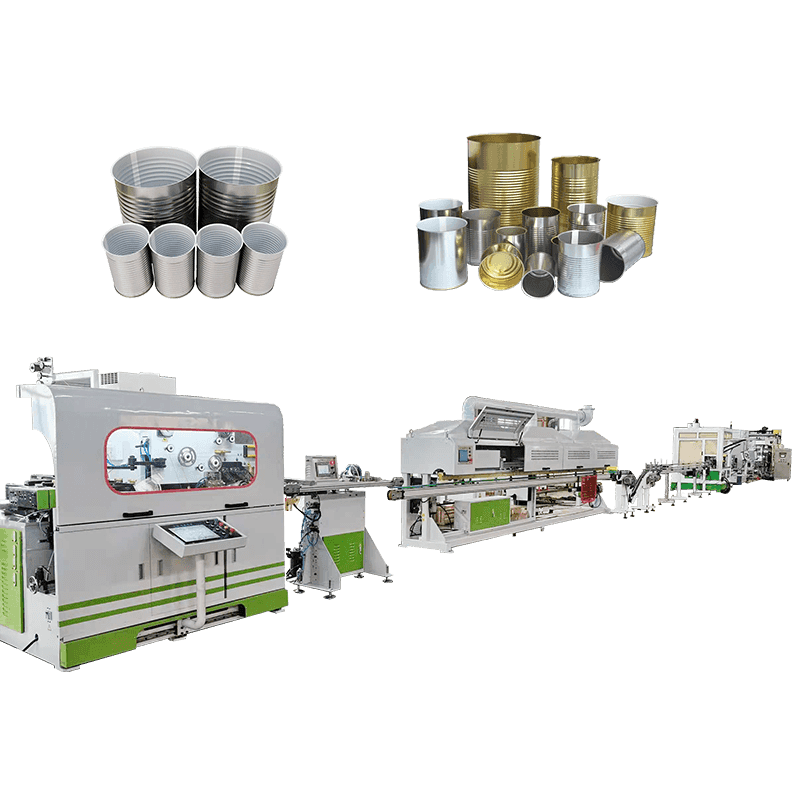
The structural framework of a tin can production line greatly affects how well it can support various automation levels. Automation-friendly machines are typically designed with modularity, allowing devices such as automatic welding machines, automatic lacquer curing units, automatic seamers, and automatic inspection systems to be combined. A 3 piece food tin can production line normally adopts a continuous-flow mechanical layout, which helps factories reduce material handling time and enhance stability. Semi-automatic configurations, by contrast, retain certain manual stages such as feeding or unloading, while the core fabrication processes proceed through mechanical systems. Both modes maintain product consistency, but the physical structure of the can production line determines how much human intervention is necessary. Since manufacturers often operate different can sizes and materials, a line that supports both automation modes offers a broader range of applications for small, medium, and large-scale factories.
Performance Differences Between Fully Automatic and Semi-Automatic Systems
There are performance distinctions between fully automatic and semi-automatic configurations, even though both serve the purpose of forming 3 piece cans. A fully automatic 3 piece food tin can production line generally emphasizes continuous processing with minimal human involvement. This type of system tends to maintain a stable cycle rate, especially in welding and seaming sections, where consistent alignment is required. In semi-automatic configurations, the operator typically intervenes in the loading, unloading, or transitional steps, which introduces slower cycle times. However, semi-automatic setups offer flexibility for small-batch manufacturing or facilities with limited automation budgets. The differences between these systems do not necessarily indicate superiority of one over the other; instead, they represent operational suitability for different production circumstances. Many factories choose to gradually transition from semi-automatic to fully automatic configurations as production volume increases.
Integration of Control Systems in a can production line
Automation function in a modern can production line is supported by its control framework. Programmable logic controllers handle timing, speed regulation, error correction, and synchronization between equipment units. In a fully automated 3 piece food tin can production line, the control system manages all stages from sheet feeding to can body transfer and seam formation. In semi-automatic systems, the control framework still manages core operations such as welding, but manual steps are integrated into the sequence. Human-machine interfaces offer operators access to alarm logs, speed settings, and parameter adjustments. The complexity of control integration varies by automation level, but each configuration focuses on ensuring stability and traceability. Many factories favor automation upgrades because modern control architecture supports remote diagnostics and real-time monitoring features.
Production Capacity Comparison
Production capacity is another factor that affects the choice between fully automatic and semi-automatic configurations. A fully automatic 3 piece food tin can production line generally maintains a relatively higher throughput because feeding, welding, curing, and seaming are executed in a coordinated sequence. Semi-automatic systems provide lower but flexible output, making them suitable for facilities focusing on product diversification rather than volume. Accordingly, both automation levels serve unique purposes depending on the target market and operational scale. The decision process involves analyzing the required daily output and calculating whether manual assistance would be feasible. Since many factories produce multiple product sizes, a tin can production line that supports adjustable speed and simplified tooling changes offers greater adaptability.
| Configuration Type | Typical Output Range | Labor Requirement | Recommended Factory Scale |
| Fully Automatic | High, continuous flow | Low | Large-scale production |
| Semi-Automatic | Moderate, batch-oriented | Medium | Small to medium-scale production |
Material Handling Requirements in Different Automation Modes
Material handling is a critical component of any 3 piece food tin can production line, especially because metal sheets, welded bodies, and can ends must be transferred without distortion. Fully automatic lines integrate mechanical conveyors, lifting devices, and alignment units to handle materials consistently. Semi-automatic solutions may rely on workers for loading or repositioning materials. The choice between these handling methods influences both workflow and the physical layout of the tin can production line. Fully automatic systems require additional space for conveyors and safety guarding, while semi-automatic lines are more compact and suitable for limited floor areas. A factory’s layout constraints often determine the practicality of automation upgrades, particularly when installing long curing ovens or high-speed welders.
Energy Consumption and Efficiency Considerations
Energy usage varies between automated and semi-automated configurations. High-speed welding, automated seam forming, and curing processes in a fully automatic 3 piece food tin can production line may require more consistent power input. However, these systems tend to maintain stable efficiency because downtime is reduced. Semi-automatic lines may consume less energy at certain stages, but idle time caused by manual transitions can reduce overall efficiency. Factories often evaluate the long-term operational cost versus energy consumption savings when choosing their configuration. Since sustainability awareness continues to increase, equipment manufacturers design both automation modes with attention to energy distribution, thermal insulation, and motor efficiency.
Maintenance Requirements of Automation Levels
Maintenance strategies differ depending on the automation level. Fully automatic systems depend heavily on sensors, motorized conveyors, servo components, and control modules. Consequently, maintenance focuses on periodic inspection of electronic components and lubrication systems. Semi-automatic systems emphasize mechanical robustness because operators interact more frequently with the equipment. Although maintenance frequency may differ, both systems require consistent inspection of welding rollers, curing chambers, seaming heads, and alignment mechanisms. A tin can production line that incorporates modular components can make maintenance easier regardless of automation level, allowing operators to replace individual units without long shutdowns.
| Automation Level | Maintenance Focus | Component Example |
| Fully Automatic | Electronic coordination and timing | Sensors, PLC modules, drive motors |
| Semi-Automatic | Manual interaction and mechanical parts | Loading tools, body transfer frames |
Scalability for Future Expansion
Scalability is a key consideration for manufacturers expecting production growth. A 3 piece food tin can production line that accommodates both fully automatic and semi-automatic setups enables incremental upgrades. Factories may choose to begin with semi-automatic feeding systems, then slowly integrate automatic welders, automatic seamers, or automatic testers into the workflow. This approach minimizes initial investment and avoids major production interruptions. The modular architecture used in many tin can production line designs supports future expansion, allowing factories to improve capacity as market demand increases. Such scalability is particularly useful for companies producing seasonal food cans or diversified packaging formats.
Quality Stability Under Different Automation Levels
Quality stability is a major factor in can manufacturing. A fully automatic 3 piece food tin can production line maintains more consistent processing speed and alignment accuracy during welding and seaming operations. This can help ensure uniform product appearance and reduced variation. Semi-automatic systems also support stable quality, although manual handling introduces a higher potential for slight variation. Inspection equipment, whether automatic or manual, plays a key role in ensuring can body consistency. A can production line that integrates optical sensors or mechanical gauges can help maintain stability regardless of automation mode, enabling factories to match their quality requirements with their chosen configuration.
Practical Decision Factors for Factories
Factories usually consider multiple factors when choosing between fully automatic and semi-automatic configurations. Budget constraints, labor availability, technical knowledge, product types, floor space, and target output volumes all influence the final decision. A tin can production line that offers flexible automation options allows factories to align production planning with long-term development goals. Practical decision-making focuses on balancing performance stability, production volume, and investment cost. Since automation does not necessarily imply universal suitability, each factory evaluates its operational capacity before finalizing its configuration.